The Widening Swing: Amplifying Variability of the Southern Annular Mode
Geophysical Research Letters (Under Review), 2025 · with Prof. Ding Ma and Prof. Ji Nie
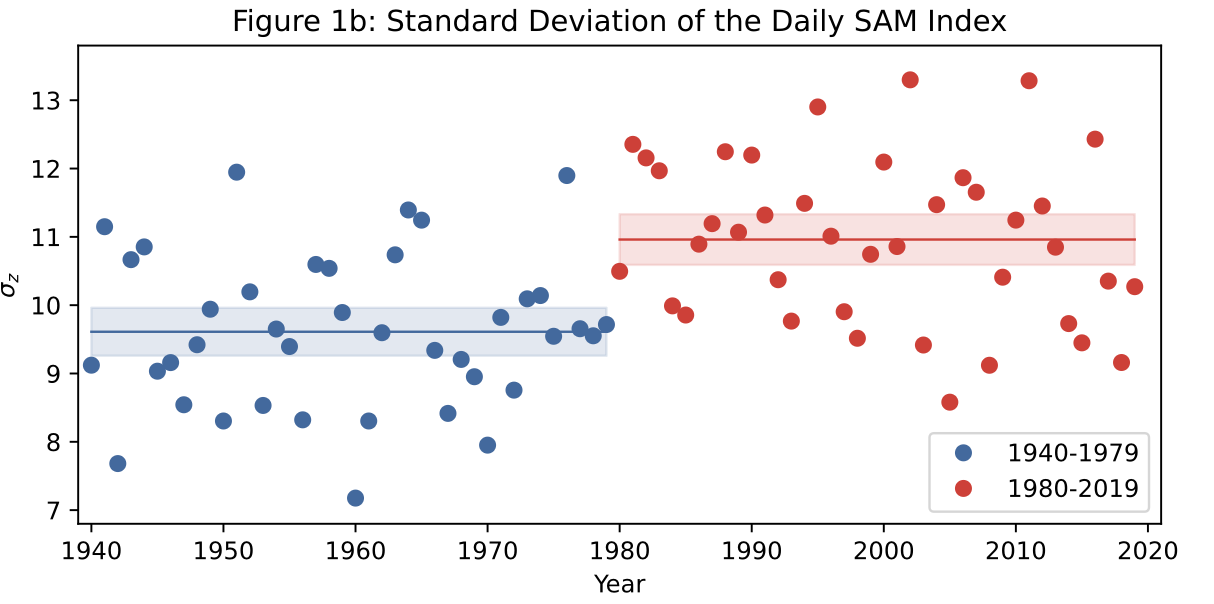
Figure 1: The standard deviation of the daily SAM index has increased significantly from 1940 to 2019.
The Hidden Signal in Climate Noise
The Southern Annular Mode (SAM) is the heartbeat of the Southern Hemisphere's weather, governing where storms hit and how much rain falls from Australia to Antarctica.
While scientists have long known that the SAM is slowly shifting towards its positive phase, we uncovered a more volatile trend: the SAM is becoming "moodier." Its day-to-day variability has increased by over 14% in the last eight decades. This means we aren't just facing a different climate mean state; we are facing more frequent and violent swings between extremes.
Mechanisms & Findings
Why is this happening? By combining observational data (ERA5 reanalysis, Australian station data) with idealized dry-core simulations, we traced the cause to a fundamental thermodynamic driver.
The Mechanism: A strengthening meridional temperature gradient (due to greenhouse warming) enhances atmospheric eddy activity. These more energetic eddies drive stronger momentum fluxes, which in turn pump more energy into the SAM's daily fluctuations.
- Historical Evidence: We detected a robust 14% increase in daily SAM variability since 1940.
- Real-world Impact: This amplification correlates directly with more intense precipitation and wind anomalies in the Southern Hemisphere.
- Future Projection: Analyzing 25 CMIP6 models under high-emission scenarios (SSP5-8.5), we project this variability will likely continue to intensify through the 21st century.